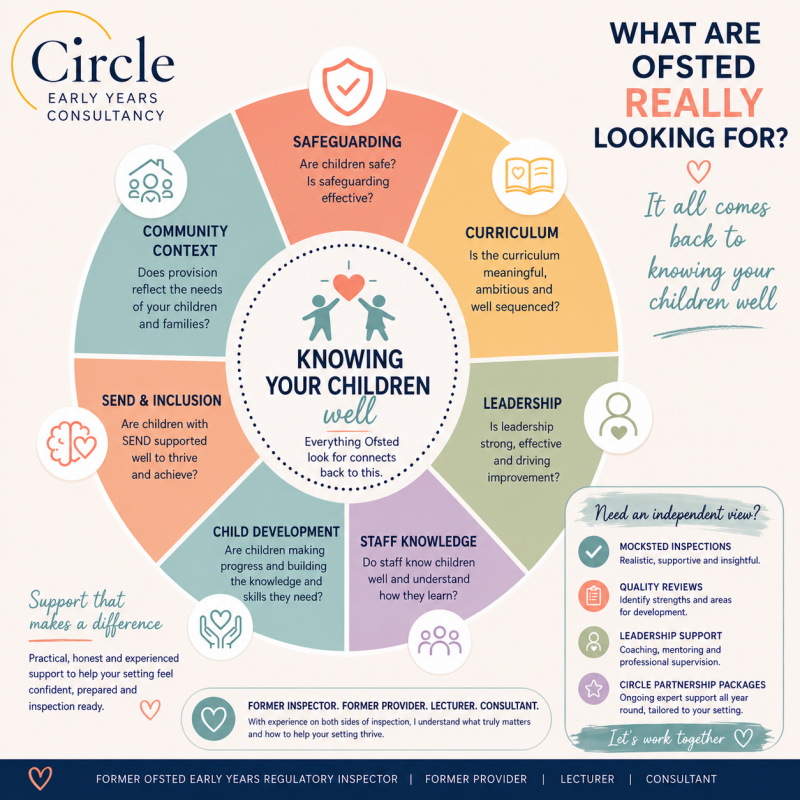
What Are Ofsted Really Looking For?
A Former Early Years Regulatory Inspector's Perspective
By Zoe Duggan, Circle Early Years Consultancy
For many nursery leaders and practitioners, the word Ofsted still creates anxiety.
I know this because I've sat on both sides of the table.
As a former Early Years Regulatory Inspector, nursery leader and now early years consultant, I've experienced inspections as both the person carrying them out and the person receiving them. I understand the sleepless nights, the overthinking and the temptation to frantically update policies at the last minute.
But here's the reality:
Ofsted are not looking for perfect paperwork.
They are not expecting a scripted answer.
And they are certainly not looking for settings that have spent weeks trying to second-guess what inspectors want to hear.
What Ofsted are really trying to establish is much simpler:
How well do you know your children, how effectively do you support them and how strong is the quality of education you provide?
What Does Ofsted Focus On During an Early Years Inspection?
While inspections cover several areas, inspectors are essentially gathering evidence around four key questions:
1. Are Children Safe?
Safeguarding remains fundamental.
Inspectors will want to see that:
- Staff understand safeguarding responsibilities.
- Concerns are identified and acted upon promptly.
- Recruitment procedures are robust.
- Children feel safe and secure.
- Leaders maintain a strong safeguarding culture.
However, safeguarding is rarely just about policies.
Inspectors often learn more from conversations with staff than from reading paperwork.
Can practitioners recognise signs of concern?
Do they understand local risks?
Would they know what to do if they were worried about a child?
These conversations often tell inspectors far more than a file ever could.
2. Do Staff Know Their Children Well?
One of the strongest indicators of quality practice is how well practitioners understand individual children.
Inspectors frequently explore:
- Children's interests.
- Next steps in learning.
- Individual needs.
- SEND support.
- Communication and language development.
- Family and community context.
Settings that know their children well are usually able to explain not just what they do, but why they do it.
3. Is the Curriculum Meaningful?
This has become an increasingly important focus.
Ofsted are interested in how the curriculum reflects:
- The children attending the setting.
- Their starting points.
- Their community and local context.
- The knowledge, skills and experiences leaders want children to gain.
A strong curriculum isn't necessarily complicated.
In fact, some of the strongest settings I inspected had simple, clear approaches that every member of staff understood.
Inspectors are often exploring questions such as:
- Why have you chosen this approach?
- What do you want children to learn?
- How does learning build over time?
- How do you know it is making a difference?
4. How Effective Is Leadership?
Leadership influences everything.
Inspectors look beyond compliance and consider whether leaders:
- Support staff effectively.
- Identify strengths and weaknesses.
- Drive continuous improvement.
- Understand their provision.
- Maintain high expectations.
One of the biggest myths about inspection is that leaders need to present a perfect setting.
In reality, inspectors are often more reassured by leaders who can honestly identify areas for development and explain how they are addressing them.
What Ofsted Are Not Looking For
Over the years I've seen many settings spend valuable time worrying about things that have very little impact on inspection outcomes.
Inspectors are not looking for:
❌ Perfect displays
❌ Colour-coded paperwork
❌ Scripted staff responses
❌ Lengthy planning documents
❌ Last-minute policy rewrites
❌ Endless evidence folders
Instead, inspectors want authentic evidence that children are safe, happy and making progress.
The New Focus: Context Matters
Increasingly, Ofsted are considering settings within the context of their community.
No two nurseries are the same.
What works exceptionally well in one setting may not be appropriate in another.
Inspectors are interested in:
- The community you serve.
- Your cohort of children.
- Levels of disadvantage.
- SEND needs.
- Language profiles.
- Local priorities.
The strongest settings can clearly explain how their provision reflects the needs of their unique children and families.
How Can You Prepare for Ofsted Without Becoming Overwhelmed?
The most effective preparation usually involves stepping back and asking:
Do we genuinely understand our strengths?
Are we clear about our priorities for improvement?
Can staff confidently explain their practice?
Do we know what inspectors are likely to ask?
This is often where external support can be invaluable.
An experienced, independent perspective can help identify strengths, highlight areas for development and build confidence long before inspection day arrives.
How Circle Early Years Consultancy Can Help
At Circle Early Years Consultancy, I support nurseries, preschools and early years settings across the UK through:
Mock Ofsted Inspections (Mocksted)
A realistic inspection experience designed to:
- Reduce staff anxiety.
- Identify strengths and gaps.
- Provide clear, practical recommendations.
- Build inspection confidence.
Quality Improvement Reviews
Comprehensive reviews focusing on:
- Curriculum
- Safeguarding
- Leadership
- SEND
- Teaching and learning
- Compliance
Leadership Coaching and Professional Supervision
Support for managers and leaders who want an experienced, independent sounding board to help navigate challenges, develop confidence and strengthen leadership practice.
Training and Professional Development
Including:
- Safeguarding
- Child development
- Behaviour and emotional regulation
- Curriculum development
- Professional curiosity
- Inspection readiness
Ongoing Circle Partnership Support
For settings seeking longer-term support, regular consultancy can provide continuity, accountability and expert guidance throughout the year rather than waiting until inspection is announced.
Final Thoughts
After carrying out inspections and supporting settings through them, one thing remains consistently true:
The best inspections happen when settings stop trying to perform for Ofsted and start confidently explaining the excellent work they already do.
Inspection should never feel like a game of guessing what inspectors want.
When leaders understand their provision, know their children and can articulate their practice with confidence, inspection conversations become significantly easier.
And that is ultimately what Ofsted are looking for.
Need Support?
Whether you're preparing for inspection, looking to strengthen practice or simply want an honest external perspective, Circle Early Years Consultancy can help.
Former Ofsted Early Years Regulatory Inspector. Former provider. Lecturer. Consultant.
Practical, supportive and honest guidance to help your setting feel confident, prepared and inspection ready.
Add comment
Comments